Your suppliers, your menu, your kitchen practices, independently researched. Published on your channels, and ours.
What is Food Identity ↓Food Identity is an independent and universal credential describing how your restaurant sources, cooks and cares.
We research it from public sources; you can sharpen it with your own evidence, which deepens the published report.
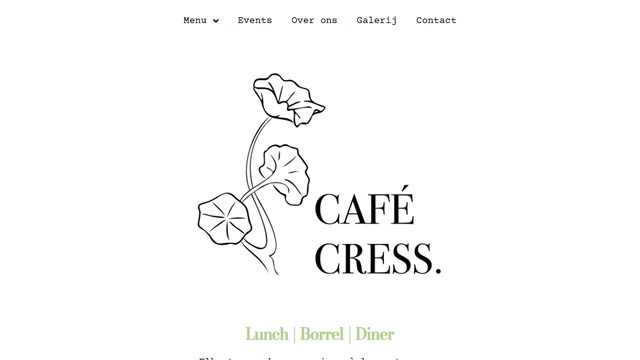
Shown: Café Cress, Amsterdam. Every restaurant's Food Identity has the same structure.
We've probably already written yours. Want to see it?
Not there yet, or want the full report? Ask us to send it.Food Identity is offered by My Treats.
My Treats is the platform that helps conscious diners find restaurants in line with their values. We do this through the My Treats app, fed by the Food Identity reports, and the restaurant widgets for other channels.
Discover My Treats ↗Restaurants who joined us early to build the standard. Their data shapes our methodology.
We research six dimensions from public evidence and add what you declare through the questionnaire. Every finding carries its evidence tier, from self-declared to audited, shown openly on the profile.
Payment never influences scores, evidence tiers, narrative or ranking. The highest score requires a current third-party audit, which we do not sell.
You confirm what is right and correct what is not. Your own evidence deepens the report, and your own words are labelled as yours, so a guest always knows who said what.
The Food Identity widget puts your independent profile on your own site, where your future guests already are. And it's free.
The widget surfaces how you source, cook and care in a structured, evidence-tiered form. An external review strengthens your credibility. We also show the other external recognitions you hold.
The widget carries reservation nudges, from a Reserve button to a welcome gesture for visitors who hesitate. Every tap towards your booking page is counted, and reported to you.
A short feedback function asks visitors what they could not find. You learn what your future guests are looking for, before they call to ask.
Some examples:
Stronger than self-claiming. Less costly than certified audits.
Payment never influences scores or ranking.
One extra reservation a month triggered by the widget covers these costs already.
Monthly subscription, no commitment
Sharpen my profile, for freeWe switch on the paid features for thirty days, for free: the Reserve button, the welcome gesture, the report. No card, no auto-renew; it ends by itself. On day 30 you have your first report and you decide. If you stop, Shine stays on your site with every fact and score.
Guests increasingly choose restaurants whose sourcing and practices stand up to a closer look.
A complete profile lifts that decision in your favour,
on your own channels and ours.
Your name, number and restaurant first, then your kitchen's answers: suppliers, practices, certifications, photos. No account.
FreeWe read your answers and look at your restaurant. Where something needs clarifying or validating, we call you.
FreeTwo short lines where the widget should sit, a two-minute intervention. The widget keeps itself up to date.
FreeFor restaurants and guests to find each other based on values,
not marketing spend.
Restaurants sourcing responsibly, reducing waste, or creating inclusive, plant-forward menus, or all of the above, have a hard time conveying what they do clearly and credibly. Guests who would value that work are often unaware of the underlying commitments. We built Food Identity to serve both: helping restaurants tell their story with credibility, and helping guests find restaurants in line with their values.
What is hidden becomes visible. Your chef's story, your menu narrative and your full gallery join the evidence in the widget, on your own site.
The Reserve button and the welcome gesture turn reading into a tap towards your booking page. Every tap is counted and reported to you each month.
The feedback loop tells you what information visitors are missing. Corrections and updates are handled with priority.
Your profile is probably already live. Sharpen it in about 10 minutes, free.
Sharpen my profile, for freeIf you're certified by a recognised audit authority such as SRA Food Made Good, Green Key, or B Corp, and willing to share the full detailed audit report with us, we integrate it as evidence. Your audited dimensions ship at the highest evidence tiers automatically. Less work for you, more credibility for diners.
Six dimensions, scored 1 to 5 on the SEERO scale: Starting, Engaged, Endorsed, Recognised, Outstanding. A strict three-year recency rule. We do not certify. We assess.
Local sourcing, seasonal cooking, low waste and circular practices, sustainable animal products, social impact, plant-forward menu. Each rated 1 to 5 against descriptive criteria, not generic scores.
Starting, Engaged, Endorsed, Recognised, Outstanding. The impact score reflects how many dimensions are credibly covered, not just an average score.
When evidence supports either of two levels, we assign the lower. Independent corroboration strengthens both scores and evidence tiers. A score of 5 always requires a current, recognised third-party certification.
Every claim carries an evidence tier (self_declared, researched, partially_audited, or audited), shown openly on the published profile.
No level above 2 may rest on sources older than three years. The profile is a point-in-time view, not a historical record.
Payment never influences scores, evidence tiers, narrative, or ranking. Public-source scores are not capped for commercial reasons. Paid tiers buy conversion features, a richer widget and a monthly report, not editorial outcome.
We assess. We do not certify, audit, or endorse. Restaurants reference our published profiles; they do not display badges or seals.
The evidence tiers map to the substantiation hierarchy under EU directive 2024/825 (Empowering Consumers, effective September 2026). A published profile is a structured, source-cited editorial publication that restaurants can cite when building their own substantiation file.
These eight rules summarise the framework. The full SEERO methodology, including the dimension-by-dimension scoring rubric, the score derivation logic, the sourcing signals, and the evidence tier definitions, is published at mytreats.app/SEERO ↗.
We collaborate with specialist guides, certification authorities, and distribution channels. We integrate them, reference them, and distribute with them. So that we all benefit.
Recognised certifications we integrate as evidence. Their audits lift evidence tiers in our methodology.

Specialist guides and movements whose coverage strengthens an assessment as third-party validation.



Channels that distribute our restaurant data to consumers, and institutions that support our work.



My Treats has received funding from the European Union. Views and opinions expressed are those of the authors only and do not necessarily reflect those of the European Union.

From 27 September 2026, environmental claims a business makes to consumers require verifiable substantiation under the EU Empowering Consumers Directive (Directive 2024/825). That includes specific claims such as local sourcing, seasonal menu, sustainable fish, low waste, social impact.
Your published profile is a structured, source-cited editorial publication you can reference when building your own substantiation file. It is most useful to higher-end independents, group operators, and certifier-aligned restaurants who routinely make and publish environmental claims. We are not a certification body; compliance remains your responsibility.
Each evidence tier is named on your published profile. Every claim is tied to its source: declared by you, observed in public reporting, or backed by an external recognised auditor.
You provide the evidence. We structure, score, and publish it as an editorial assessment. You keep using your own language, citing the assessment as you would cite any editorial source. Compliance remains your responsibility; we publish the underlying evidence in a form you can draw on.
We started My Treats because we were both frustrated, in our own ways. Jonathan, a food-loving guest, kept asking himself: where did this ingredient come from? Who cooked it? Whose recommendation can I trust? Thijs, a restaurateur who'd run a Michelin-starred restaurant built on seasonal produce, ethical sourcing, and careful sourcing relationships, kept asking the opposite question: how do my guests find out any of this?
Plenty of restaurants are already doing things right. There's just no clean way to surface it. So we built what we were both missing: a way to eat out more consciously, more transparently, without losing the joy.
Jonathan and Thijs, founders
Watch our story (3 min) ↗Most restaurants start with the free questionnaire and switch on Optimised when the first report is in hand. You can do either.
From 27 September 2026, environmental claims a business makes to consumers require verifiable substantiation under the EU Empowering Consumers Directive (Directive 2024/825).
That includes specific claims a restaurant might use today, such as local sourcing, seasonal menu, sustainable fish, low waste, social impact.
A My Treats published assessment is an editorial publication that restaurants can cite when building their own substantiation file. Compliance remains the restaurant's responsibility; we provide structured, source-cited evidence.
Read the full section ↓